 EN
EN  ไทย
ไทย 
Resources, Waste and Pollution Management
The transportation industry plays a critical role in driving economic growth; however, its operations inherently generate waste and pollution throughout the value chain. While the Company primarily operates as an intermediary between customers and international logistics service providers, we recognize the responsibility to manage resources efficiently and mitigate waste and pollution arising from our operations—particularly within trucking services and warehousing activities under the direct control. The Company is committed to conducting its business with a strong focus on efficient resource utilization, environmental impact prevention and reduction, and the promotion of long-term sustainable growth.
The Company places significant emphasis on systematic resource management, as well as waste and pollution management, by adopting the 3R principles (Reduce, Reuse, Recycle) as the foundation of our operations. This approach aims to minimize unnecessary resource consumption, reduce waste and pollution generation at the source, promote the reuse of materials and equipment, and ensure proper waste segregation, recycling, or disposal in accordance with applicable laws and relevant standards.
These practices are embedded across all operation of our value chain, covering from resource planning and optimization in logistics operations, fuel and energy management, and the management of waste generated. The Company also strives to control and reduce pollution that may impact on the environment, communities, and other stakeholders. Our key initiatives include:
• Promoting the reuse of resources where feasible, such as encouraging double-sided paper use and reuse the document envelopes;
• Reducing water consumption through awareness campaigns to ensure water is used responsibly;
• Encouraging proper waste segregation; ranging from employee awareness initiatives to waste separation activities, to enhance the value of recyclable materials.
Looking ahead, the Company plans to further enhance our operational efficiency across all processes and services by applying Life Cycle Assessment (LCA) principles to better understand and manage environmental impacts.
The Company believes that efficient resource utilization and effective waste management under the 3R framework not only reduce operational costs and environmental risks but also create added value to the business, strengthen trust among customers, partners, and the society, and serve as a key foundation for the long-term sustainable development of logistic business. In 2025, the Company recorded zero environmental complaints and no cases of environmental fines or penalties.
Performance Overview
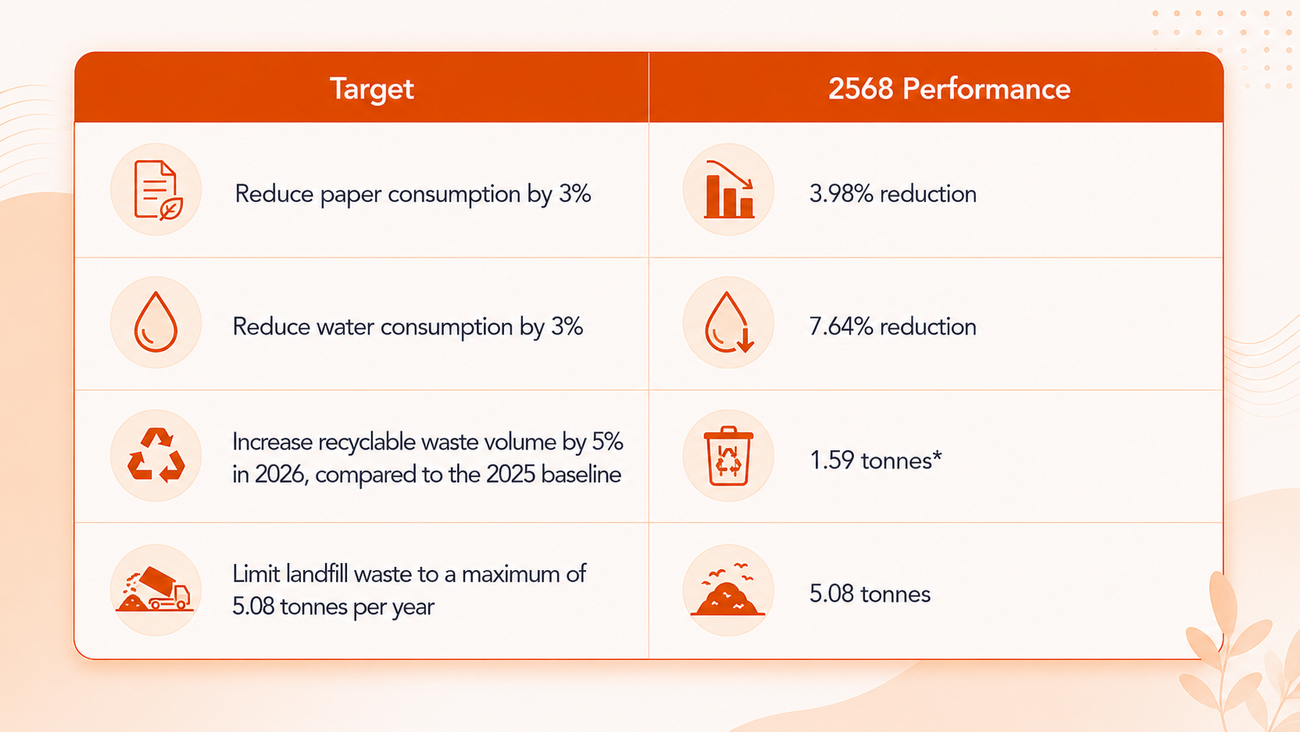
To ensure effective resource and waste management, the Company has designated 2025 as the baseline year for waste management as well as set the target on reducing general waste to landfill waste at no more than 140 liters per day, or 5.08 tonnes per year, based on municipal fee records. The Company aims to maintain this target in 2026 and further reduce it by at least 3% by 2027.
For recyclable waste, the Company has implemented a systematic process for measurement and disposal through licensed waste collectors. Recyclable waste categories include plastic bottles, glass, cartons, cans, and paper. The Company has set targets to increase the volume of recyclable waste by 5% in 2026 and 10% in 2027, compared to the 2025 baseline, to promote efficient resources utilization.
In terms of resource consumption, due to the nature of the Company’s operations, which involve a significant volume of documentation, the Company recognizes the importance of reducing paper usage. The Company has set targets to reduce paper consumption by 5% by 2026 and 10% by 2027 through the promotion of electronic documentation systems and paperless operations within the organization. In 2025, the Company successfully reduced A4 paper usage from 3,091 reams in 2024 to 2,968 reams, representing a 3.98% reduction, and has designated 2025 as the baseline year for ongoing reduction targets.
In 2025, the Company’s water consumption was also reduced by 7.64% compared to the year 2024 through awareness campaigns, of which encouraging all employees in the office and warehouse unit to turn off water after use, thereby promoting efficient water use.
In addition, the Company emphasized the importance of environmental awareness and social responsibility among all employees. This was achieved by promoting employee participation in training programs and sustainability-related activities to enhance understanding and encourage environmentally responsible behavior across the organization.
e-Tax Invoice/e-Receipt Project
The Company implemented the e-Tax Invoice and e-Receipt system to replace paper-based documentation starting from 1 November 2025, with the key objective of reducing paper consumption. Within the first two months of implementation, the initiative reduced paper usage by 34 reams, equivalent to 0.0782 tonnes. The project also contributed to reducing waste generation and greenhouse gas emissions associated with document preparation and delivery processes. The initiative resulted in a reduction of approximately 250 kgCO₂e, equivalent to the annual carbon sequestration capacity of approximately 26 trees.
This initiative represents one of the Company’s key efforts in driving the transition toward a greener organization. In 2026, the Company plans to expand the scope of this initiative through the implementation of an e-Withholding Tax (e-W/H Tax) system for issuing tax documents to suppliers. The system is currently under development by the FWD platform and is expected to be operational by the second quarter of 2026.
The “Separate Waste Properly,Good for the Heart”
To promote employee engagement at all levels in waste recycling, the Company has implemented this initiative starting with the installation of various designated waste separation bins by categories on every floor of the office building. These waste disposal bins are supported by visual signage to clearly indicate recyclable waste categories and facilitate proper separation practices.
The Company then conducted communication and awareness campaigns to inform employees about the value generated from recycling efforts. Employees are regularly updated on key performance indicators (KPIs), covering the total volume of waste segregated, revenue generated from recyclable materials, and the amount of greenhouse gas (GHG) emissions reduced (measured in kgCO₂e), and the equivalent number of trees preserved annually through recycling activities.
In 2025, the Company achieved a reduction of 1,459 kgCO₂e in greenhouse gas (GHG) emissions, equivalent to preventing the loss of approximately 305 trees per year, while generating a total value of THB 4,804 from recyclable materials.
In 2026, the Company plans to further strengthen employee participation by enhancing educational and awareness materials regarding waste segregation, including improved instructional signage at recycling points across all office floors. The Company will also continue to communicate recycling results on a regular basis, to sustain engagement and reinforce a culture of responsible waste management.
2025 Employee Uniforms Made from Recycled Materials
The Company has continued its sustainable procurement practices for the second consecutive year by sourcing employee uniforms from recycled materials, such as plastic bottles and coconut shells. This initiative reduced carbon emissions by approximately 3,364.08 kgCO₂e, reflecting the Company’s ongoing commitment to Green Procurement and environmental impact mitigation.
Strengthening Environmental Awareness Within the Organization
The Company has implemented initiatives to enhance environmental awareness and foster a sustainability mindset across all levels of the organization. In 2025, the Company conducted the “Developing Extraordinary ESG Leaders” training program to strengthen the engagement of executives and leadership teams in defining a clear and aligned sustainability vision. This initiative was developed in consideration of the Company’s current business context and is linked to its long-term Green Logistics goals and the Jump program.
In addition, the Company launched the “ESG Point: The More You Care, The More You Earn” initiative in 2025 to encourage employees to participate in environmentally friendly activities in their daily lives. Employees are invited to share simple and practical eco-friendly actions, such as using reusable cups instead of single-use plastic cups or choosing stairs over elevators, to accumulate points that can be redeemed for rewards. A total of 52% of employees participated in this program. The Company also provides ongoing knowledge-sharing to enhance employees’ understanding of environmental conservation and sustainability practices.
Building on this initiative, the Company further extended the ESG Point program in 2025 through the “Waste for Eggs” campaign, which encourages employees to bring recyclable waste—such as plastic bottles, plastic cups, and cardboard—for exchange with essential goods, such as eggs or instant noodles, while also earning ESG Points for rewards. This activity aims to enhance employee motivation in reducing waste while promoting recycling in an engaging and practical manner.
Target & Performance
Note: 2025 represents the initial year of data collection and reporting and has been designated as the baseline year for performance measurement.
Summary Table of Resource Efficiency and Waste & Pollution Management Data
Note: The Company’s operations do not result in the emission of Nitrogen Oxides (NOx), Sulphur Oxides (SOx), or Volatile Organic Compounds (VOCs).
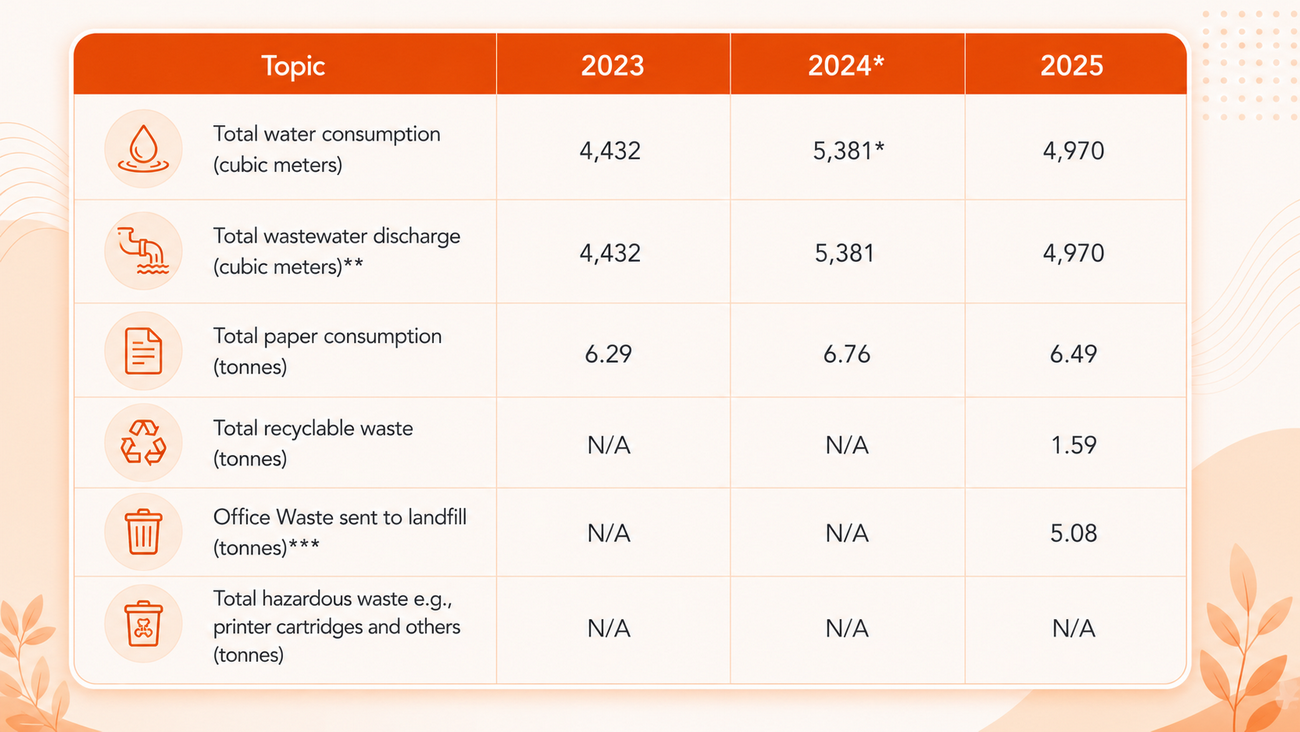
* In 2024, water consumption data collection was expanded to cover two additional branches.
** The Company’s water consumption primarily arises from office sanitary usage. Therefore, wastewater generated is discharged into the municipal wastewater treatment system in the operating area.
*** The Company’s operations do not generate hazardous waste. Empty printer cartridges are collected and managed by the printer service provider, while all batteries used are rechargeable.